A season is judged by the file it leaves, not by the season
The confirmation work is finished when a reviewer, a second partner or an inspector can open one paper per confirmation and see what was asked, what came back, what a machine proposed, who accepted it, and what was done where nobody answered. Everything below is what the platform writes without being asked to.
9 numbered sections, in this order
1. Request sent
The counterparty, the instrument, the as-of date, the language, the address it went to and how that address was established — with the deadline the letter itself named, frozen as the letter said it.2. Response received
The date, the route it arrived by, and who the reply came from — the sender the message was actually authenticated as, beside whatever the message claimed about itself where the two differ.3. Extraction & verification
What was read out of the reply, and every check applied to it: whether the figure appears in the document as words a reader can find, whether the as-of date matches, whether the currency matches. Each check named, with its result.4. Reconciliation
The client's figure beside the confirmed figure and the difference, and where there is a difference, the explanation on file and the part of it still unexplained. On an enquiry there is nothing here to reconcile — section 3 above is where the paper states why, naming the instrument rather than leaving a reader to infer it.5. Alternative procedures
Where nobody answered: what was examined instead, of the kind the standard expects for that instrument, and what coverage it achieved against the amount at risk.6. Sign-off
The partner who accepted the conclusion and when — recorded, attributable, and not something a later edit can quietly rewrite.7. Evidence references
The documents behind the conclusion, each identified so a reviewer opening the file two years later can find the same one.8. Audit trail
Every recorded change to this confirmation, carrying who did it and when, in the order it happened.9. AI and machine processing
Where a model touched this confirmation, what it proposed, and the named person who accepted, corrected or rejected it. A paper that hides this is a paper a reviewer cannot rely on.
The paper is regenerated from the record on every view and every export, so a stale copy is never served, and two exports of an unchanged engagement carry the same digests for the same papers.
The paper, as it prints
- Languages
- Dutch with the English beside it, Czech with the English beside it, or English alone — the language of the request.
- Formats
- PDF, and the same paper as a spreadsheet.
- Numbering
- The same in every language, so a reviewer finds section 6 in the same place in all three.
- What has not happened
- Printed as plainly as what has: a sign-off not yet given reads as not yet given.
Enclosure — one sheet of a confirmation working paper
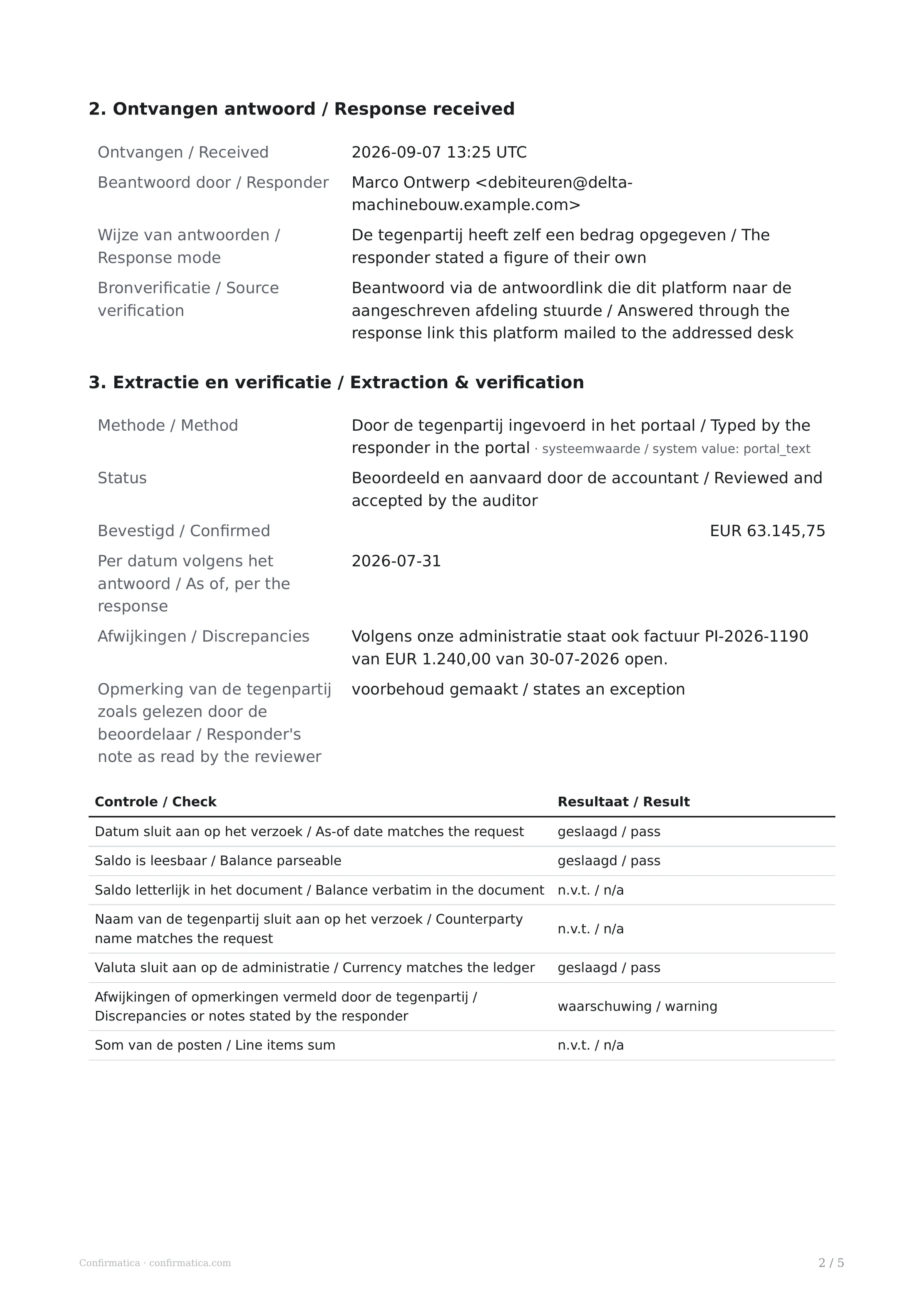
Enclosure — a difference, the explanation on file and the sign-off
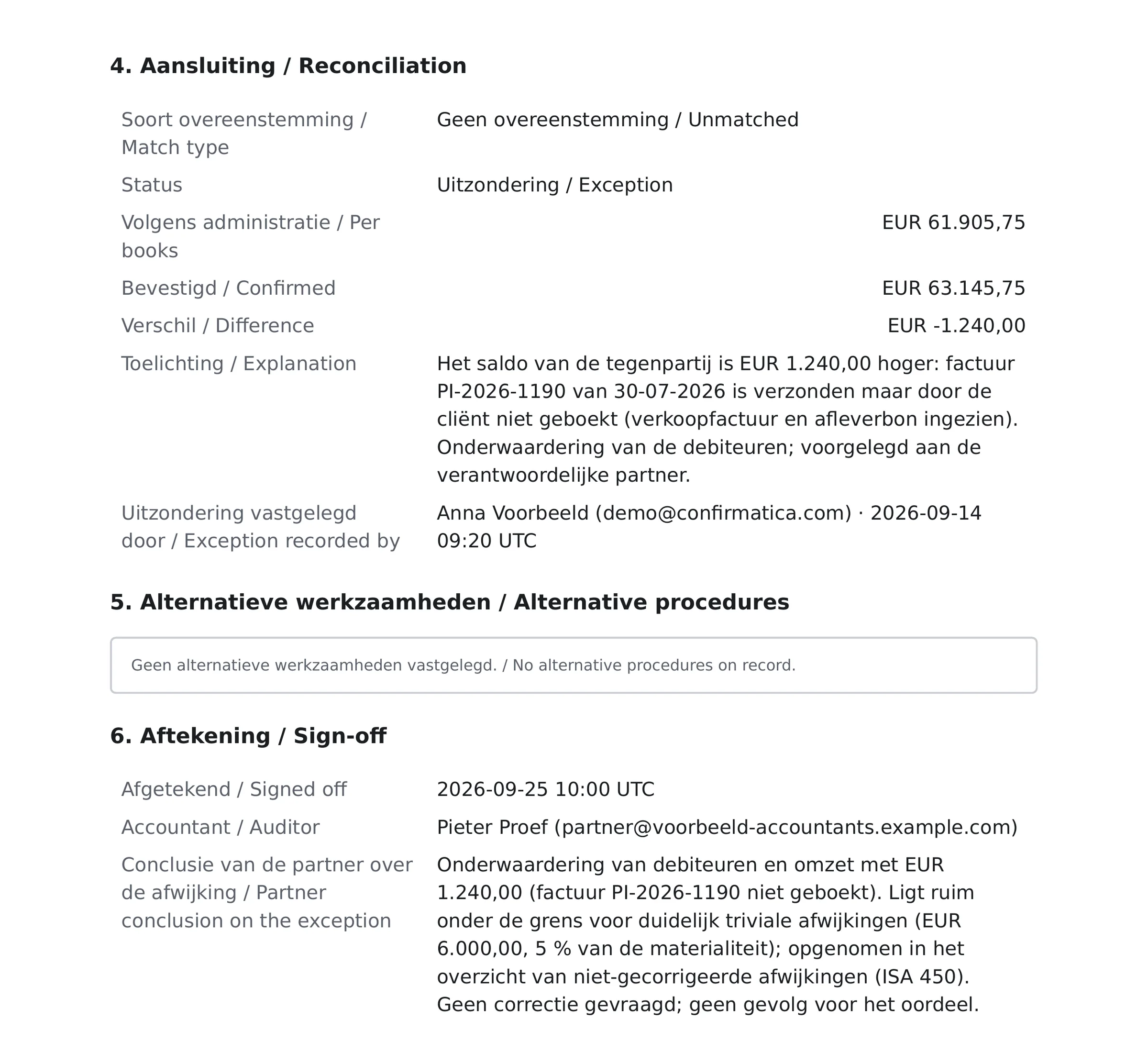
Where nobody answered, the file says what was done instead
The standard expects alternative procedures, and what counts as one depends on the instrument: subsequent receipts prove a receivable and prove nothing whatever about a lease. The platform divides that work honestly rather than claiming all of it. For a receivable and a payable it performs the matching itself and states the coverage achieved beside the amount still unsupported. For five of the remaining six it names the procedures the standard expects, and the working paper says in as many words that nothing was measured by the platform and that the auditor performs, documents and attaches the evidence. For the general instrument it names none, because it cannot know what would substantiate the balance — and says so rather than guessing.
| Instrument | Performed by | What is examined instead |
|---|---|---|
| Bank | The auditor | The statements covering the period after the date, and the cut-off over them. Named by the platform, performed and attached by the auditor. |
| Receivables | The platform | Cash received after the as-of date, matched by the platform against the invoices that made up the balance, with the coverage achieved and the amount still unsupported both stated. |
| Payables | The platform | Payments made after the as-of date, matched by the platform the same way, with the same two figures stated. |
| Legal | The auditor | Inquiry of management, inquiry of any other counsel engaged, and the minutes of the governing bodies — the ISA 501 response to a non-reply, never a ledger scan. |
| Bank relationship | The auditor | The facility and security documents themselves, the registers where a charge is recorded, and inquiry of management. |
| Insurance | The auditor | The policy documents, confirmation from the broker, and inquiry of management. |
| Leases | The auditor | The lease agreements, the record of payments made under them, and inquiry of management. |
| General | The auditor | None is named. The platform states plainly that it cannot determine what would substantiate this balance, and the auditor determines and evidences the procedures. |
Enclosure — reconciliations and alternative procedures
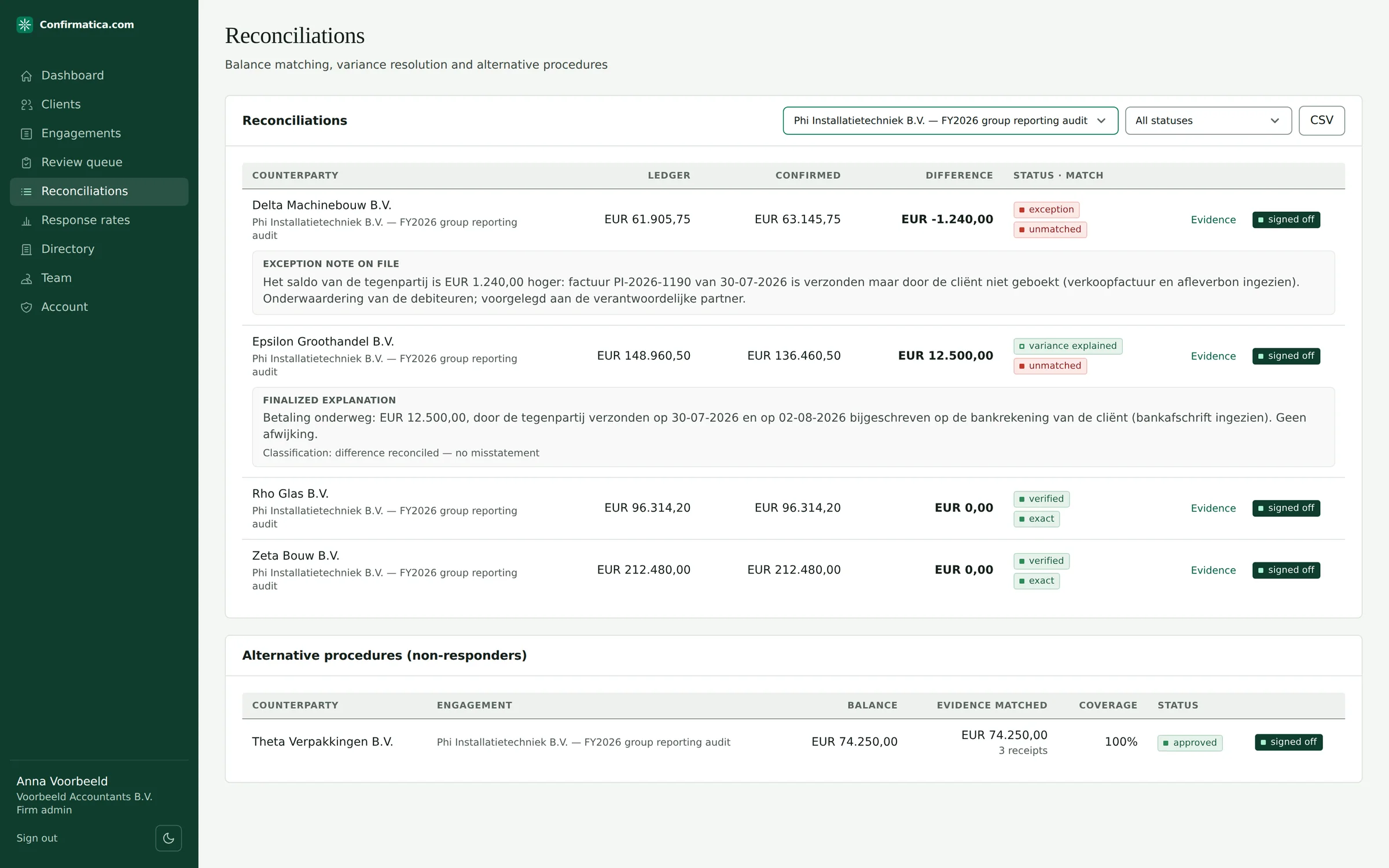
One schedule the partner signs, one export a reviewer receives
The lead schedule
Every confirmation in the engagement on one page — the instrument, the counterparty, the figure in the client's records, what came back, the difference and the state it ended in. The materiality the engagement was planned to and the basis the sample was drawn on are printed on it, because a schedule that omits them is a schedule a reviewer has to ask about.The engagement export
One file, with an index of everything inside it: the signed authorizations, the letters as dispatched, the replies as received, every working paper, and a verdict on whether the record of the engagement is complete and unaltered. Where an artefact could not be included the export says so by name rather than counting only what it managed to read. It is the artefact handed to a reviewer or an inspector, rather than a folder assembled by hand at the end.Closed means closed
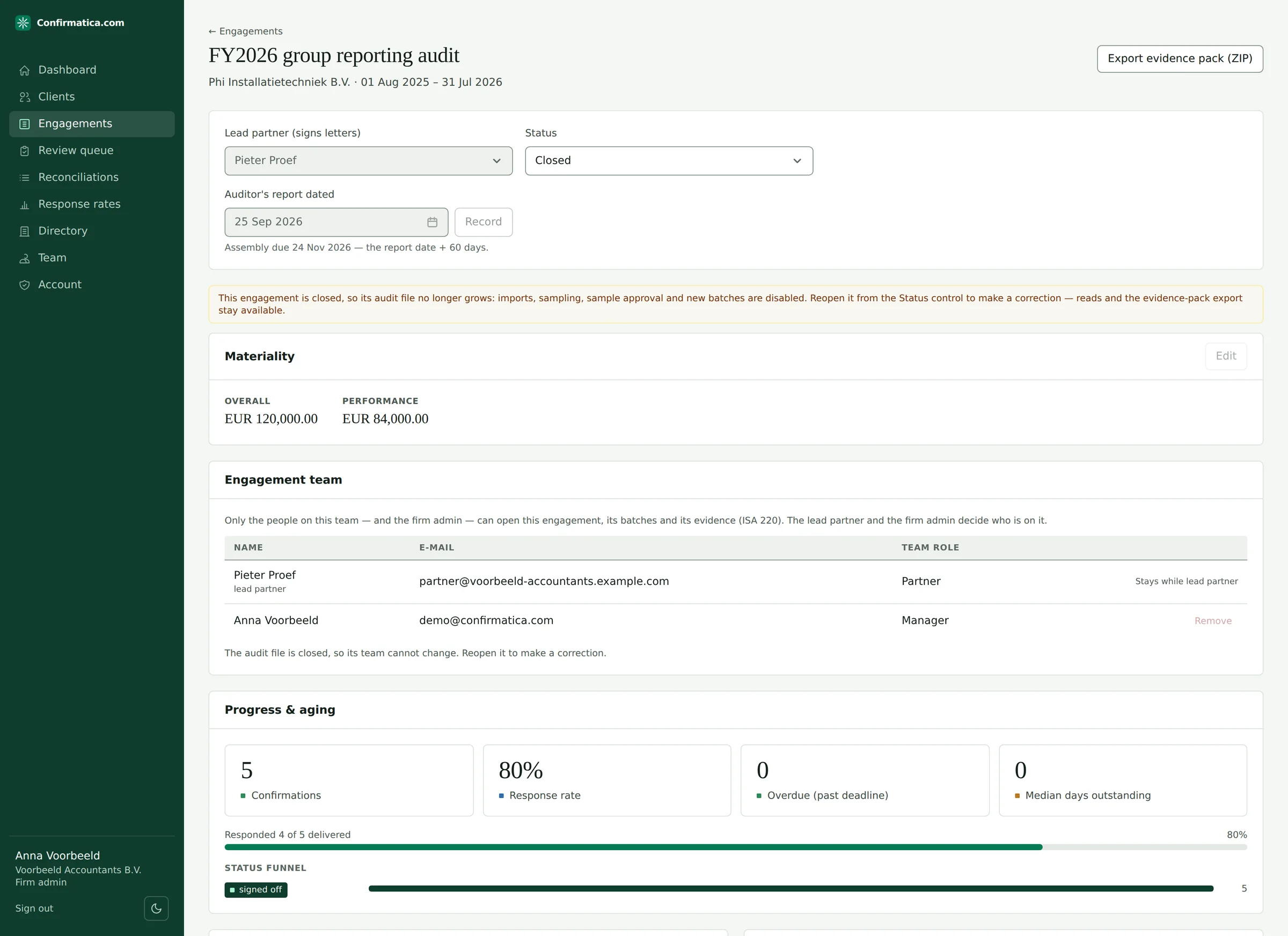
When an engagement is closed the file stops accepting conclusions. A paper cannot be added to a closed file, and reopening one cannot be done silently: the platform refuses without a written reason, and records the reason with the person who gave it. That is what ISA 230 asks of a change to documentation after the file is assembled, applied by the platform rather than left to a policy.A figure nobody sent is never a match
Where the client's records carried no figure at the time the request was sent, the paper says so in as many words. An empty cell that reads as agreement is how a confirmation with nothing behind it reaches a signed conclusion.
What a counterparty is asked, and in which language, is set out on the responders page. What the platform deliberately does not do is on the scope page, and where the file and the replies behind it sit is on the data-handling page.
Enclosure — a lead schedule, both sheets
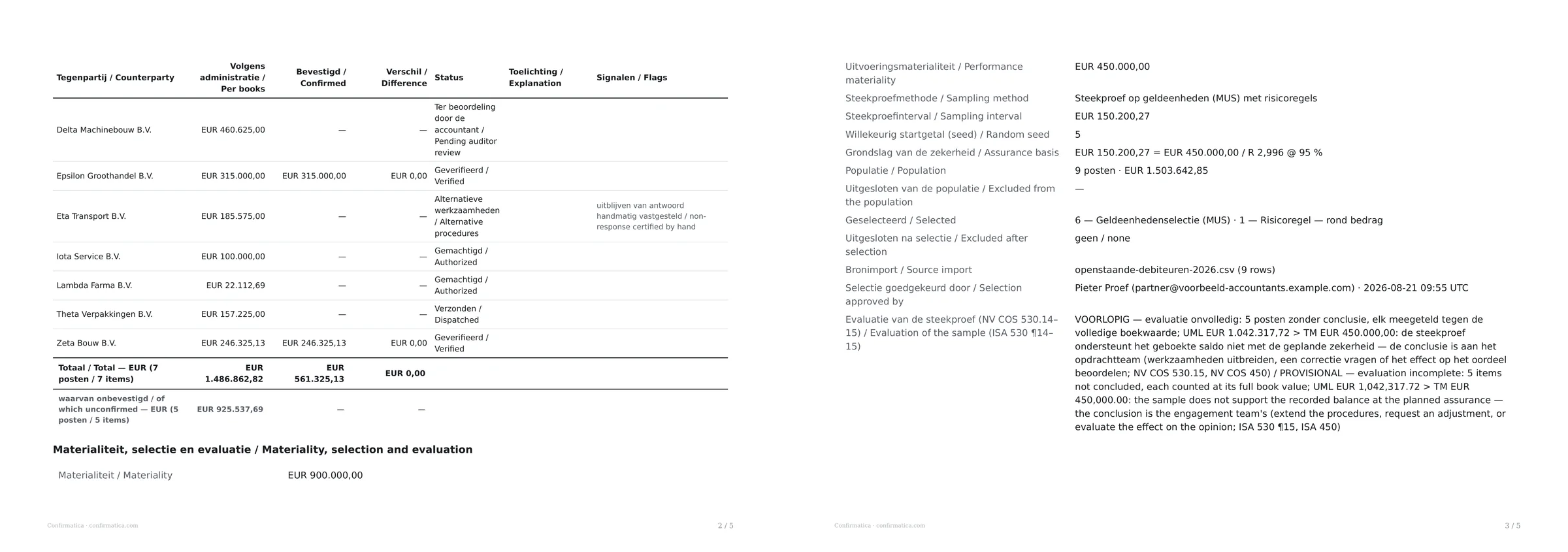
Enclosure — a closed engagement
Nothing a model produced becomes evidence on its own
Where the platform drafts a variance explanation it is labelled as a draft and is not audit evidence until a named person confirms or rewrites it. Where a figure read out of a reply cannot be found in the document as words a reader could point to, the confirmation does not pass on its own — it waits for a reviewer. The AI and machine processing section of every paper records which of the two happened.
Ask to see a finished file
The most useful thing to look at is not the season but its output: one working paper, one lead schedule and one engagement export, produced from synthetic data in a demonstration.