The confirmation is only evidence if someone answers it
A response rate is decided at the other desk. The bank clerk, the law office secretary, the insurer's administrator and the lessor's contract manager have no account, no training and no reason to make a project of it. Everything on this page exists because that desk has two minutes and no patience for a login.
Answering, refusing, or attaching what the desk already has
Step 1: A letter that names its own reply routes
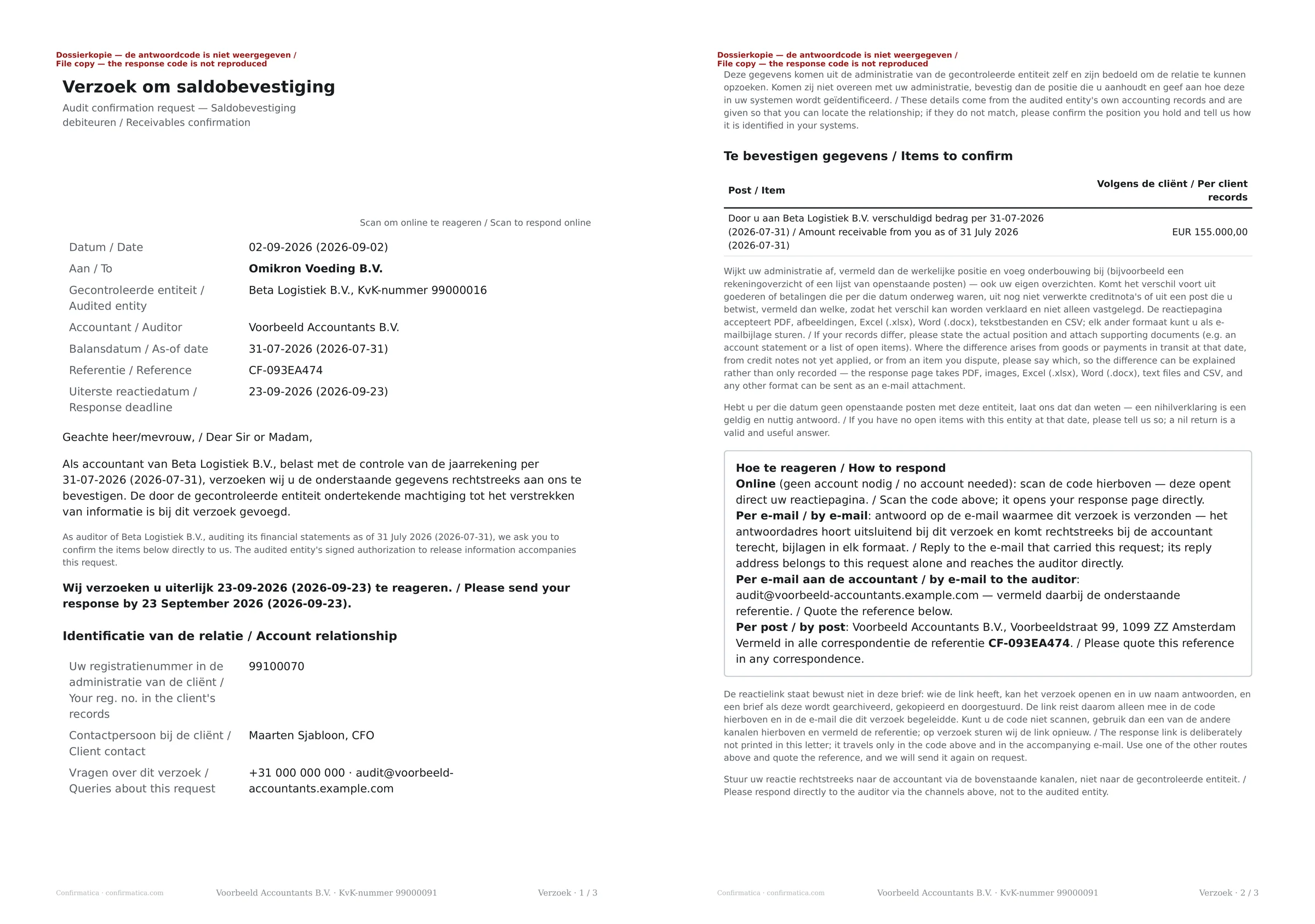
The request arrives as a PDF letter carrying the audit firm's name, its signatory and its statutory identification block, in the language of the request. What the letter prints for a human to read is a reference — non-secret, quotable on the telephone, and useless to anyone who is not the auditor. What it does NOT print, on purpose, is the response link: the letter is the artefact that circulates, filed and photocopied and forwarded onward, so the link reaches the reader only through the QR image and the covering e-mail. The address the request came from also accepts a reply directly. Nothing asks the reader to choose the “right” channel.
Step 2: The portal, opened from the link or the printed page
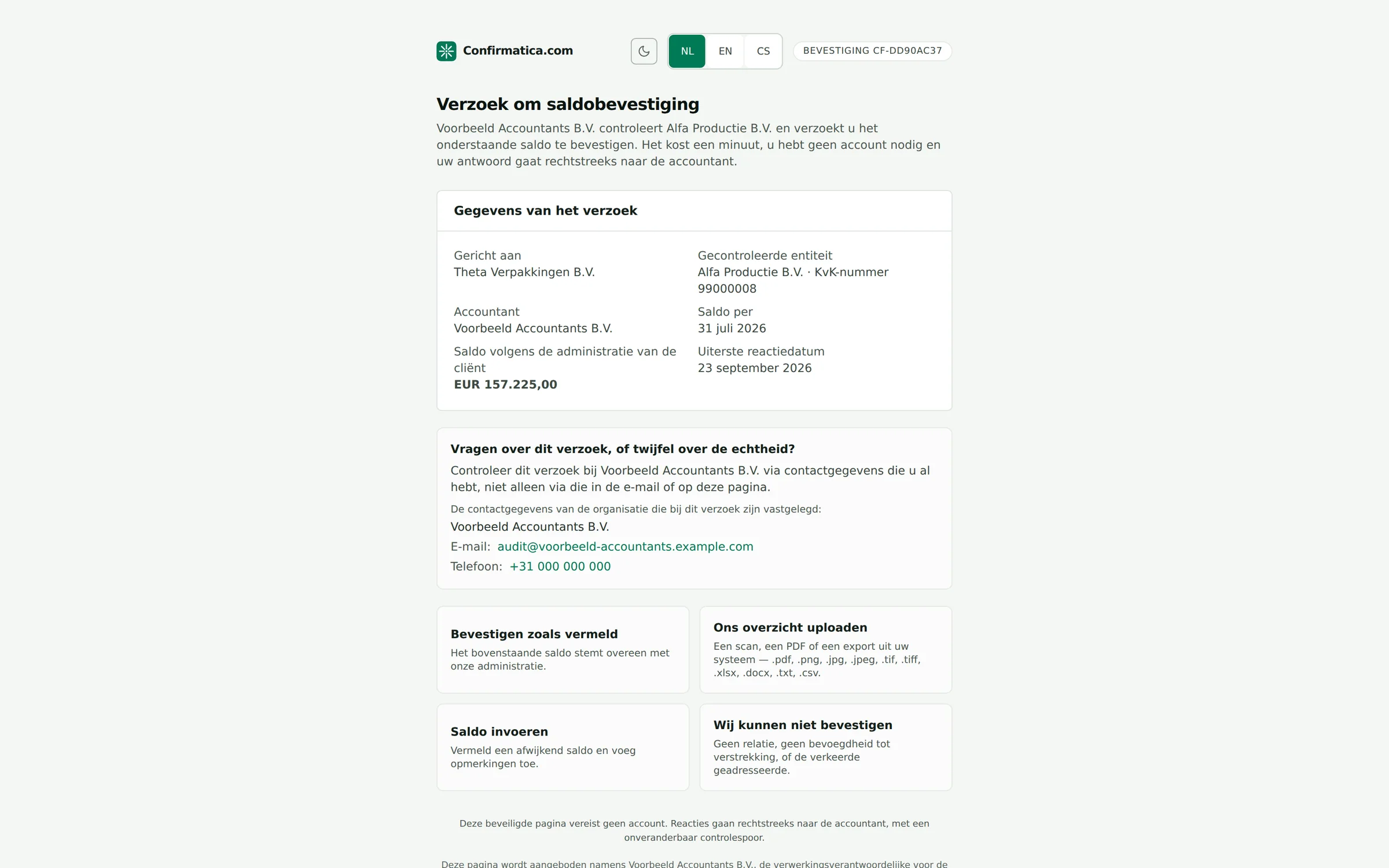
One screen, no account, no password. The portal repeats the letter's own question, drawn from the same wording the letter used, and asks only for what the instrument needs — so a desk that has mislaid the letter does not have to find it again. A responder who prefers paper can scan the QR code from the letter itself and land on the same screen, in the letter's language unless the reader chooses another.
Step 3: Or simply reply to the e-mail, with the statement attached
A reply to the address the request came from is filed as the answer, attachments and all. A desk that already has a standard confirmation letter of its own can send that instead of using the portal, and the platform files it as the response rather than asking again.
Step 4: Or attach the statement the desk already produces
A confirmations desk that runs its own report does not need to retype it. The portal takes the document as it is — PDF, image, spreadsheet, Word, CSV or text — and any other format can travel as an e-mail attachment instead.
Step 5: Or say plainly that it cannot confirm
A desk whose policy forbids confirmations, or that cannot identify the entity, has its own answer rather than silence. The audit file records that as a refusal and not as a non-response — a distinction ISA 505 draws and the working paper prints, because a counterparty who declined has told the auditor something, and one that never replied has not.
Step 6: A receipt, so the desk knows it is finished
The portal confirms what was recorded and when. The point is the second visit that never has to happen: a responder who cannot tell whether an answer arrived will either answer twice or stop answering.
The reply is asked for in the responder's own language
A Dutch or Czech letter carries the English beside it, so a legal desk reading a clause in either language is reading the same sentence; an English letter is simply English.
The letter
Statutory labels follow the audit firm's own jurisdiction, so the document a counterparty receives reads as correspondence from that firm.The portal
The same three languages, switchable by the reader on the screen — the desk that opens the link decides, not the auditor who sent it.Every message
The request, the reminders and the receipt, each in the language the request was written in. Every other message the platform sends — the ones the audited company's director receives — follows the same rule in its own language.
4 kinds carry a figure. 4 are answered in writing.
All four print the audited entity's own figure where its ledger carries one; what differs is the question asked of it. A bank letter asks the desk to confirm the balance above, to state whether it is in credit to the audited entity or overdrawn at that date, and to say which currency the account is held in — because a bare amount agreed is a balance the client holds as cash and the bank holds as an overdraft, recorded as agreement. A payables letter asks the supplier for the amount owed to it according to its own records, whether or not it agrees, with a statement of open items including invoices issued and not yet settled, because a payables confirmation is performed for completeness and an unrecorded liability shows itself in the creditor's own figure rather than in a disagreement with the entity's. A receivables letter asks the desk to state the actual position where its records differ, and to say whether the difference is goods or payments in transit, a credit note not yet applied or an item in dispute, so the difference is explained rather than only recorded. A general-balance letter asks the same open question without naming those items — a loan, a deposit or an intercompany position is not explained by goods in transit — and asks the desk to say what accounts for the difference. The one row that carries no amount is the exception: where the client's ledger holds no figure the letter states none and asks the desk for the amount from its own records instead — and a blank bank row still asks whether the account is in credit or overdrawn and in which currency it is held — because there the responder's own figure IS the evidence. An enquiry asks a desk to state what it knows, and is never asked to certify a figure it did not produce. ISA 505 is the standard all of it serves.
Answered with a figure
Bank
The balance held on an account at the as-of date, addressed to the bank's confirmation desk with the IBAN or account number printed so the account can be located without a phone call.
Receivables
The amount a customer owes the audited company at the as-of date, confirmed by the customer against its own books — the classic positive confirmation of a debtor balance.
Payables
The amount the audited company owes a supplier at the as-of date, confirmed by the supplier — the same letter with the direction of the balance reversed.
General
Any other balance a file needs a third party to confirm — a loan, a deposit, an intercompany position — using the same letter, the same portal and the same evidence trail.
Answered in writing, never as a balance
Legal
An ISA 501 inquiry to the company's lawyers: pending or threatened litigation, claims and assessments, unbilled fees, and anything else relevant to the audit. It is answered in writing, never as a balance — the platform prints no figure on a legal request and offers none to confirm.
Bank relationship
What a bank is asked once rather than per account: every account it holds, loans and credit facilities with their limits and terms, guarantees and sureties given or received, security and pledges and over which assets, and who may sign. It is answered in writing, never as a balance — the platform prints no figure on it and offers none to confirm.
Insurance
What an insurer confirms about the cover it provides: every policy in force at the as-of date and those cancelled during the period, the sums insured and limits of indemnity and the deductibles and exclusions under them, the claims notified, and the premiums outstanding. It is answered in writing, never as a balance — the platform prints no figure on it and offers none to confirm; the premium the insurer states is read against the client's records, not reconciled.
Leases
What a lessor confirms about the leases it has granted: every lease and rental agreement in force at the as-of date and those ended during the period with their assets, dates and remaining terms, the amount outstanding on the lessor's own basis with the payment schedule, the payments received in the period, and the residual value guarantees, options and security. It is answered in writing, never as a balance — the platform prints no figure on it and offers none to confirm; the amount the lessor states is measured on the lessor's basis, not the client's, so it is read against the lease schedule and not reconciled.
The refusals that protect the person replying
Never to confirm a balance on an enquiry
A litigation, bank-relationship, insurance or lessor request carries no figure, and the platform refuses to put one on it at every door a figure could enter by — the screen where a request is edited, and the file an engagement is imported from. A Confirm as stated button against a number nobody sent is how an enquiry becomes a balance match that no partner would sign.Never to create an account
No registration, no password, no portal credentials to lose, and no one-time code to fetch from another window — that step belongs to the audited company's director signing an authorization, not to the counterparty answering a request. The link is single-purpose and it expires.Never to route the reply for the auditor
An answer that arrives by post or by fax is filed by the audit firm through its own door, with the route, the date received and the person who received it recorded. The responder does not have to use the platform at all. An answer given on the telephone is not one of those routes and is not a confirmation (ISA 505 ¶A18): what the auditor records is a note, followed by a written request or the paragraph 12 procedures.Never to answer the audited entity
The request goes to the counterparty and the reply comes back to the audit firm. The audited entity authorizes the release of the information and does not stand between the two.
The counterparty who never replies is an audit problem, not an inbox problem
Reminders go out on the schedule set for that batch of requests, in the language of the request. When a desk still does not answer, the platform does not leave the file with a gap: the confirmation moves to a state that says so, and the alternative procedures the standard expects are prepared against evidence of the right kind for that instrument — subsequent receipts for a receivable, payments and statements for a payable, the agreements themselves for a lease. What the file receives is set out on the audit file page.
A response rate is decided at the other desk, and the platform measures it
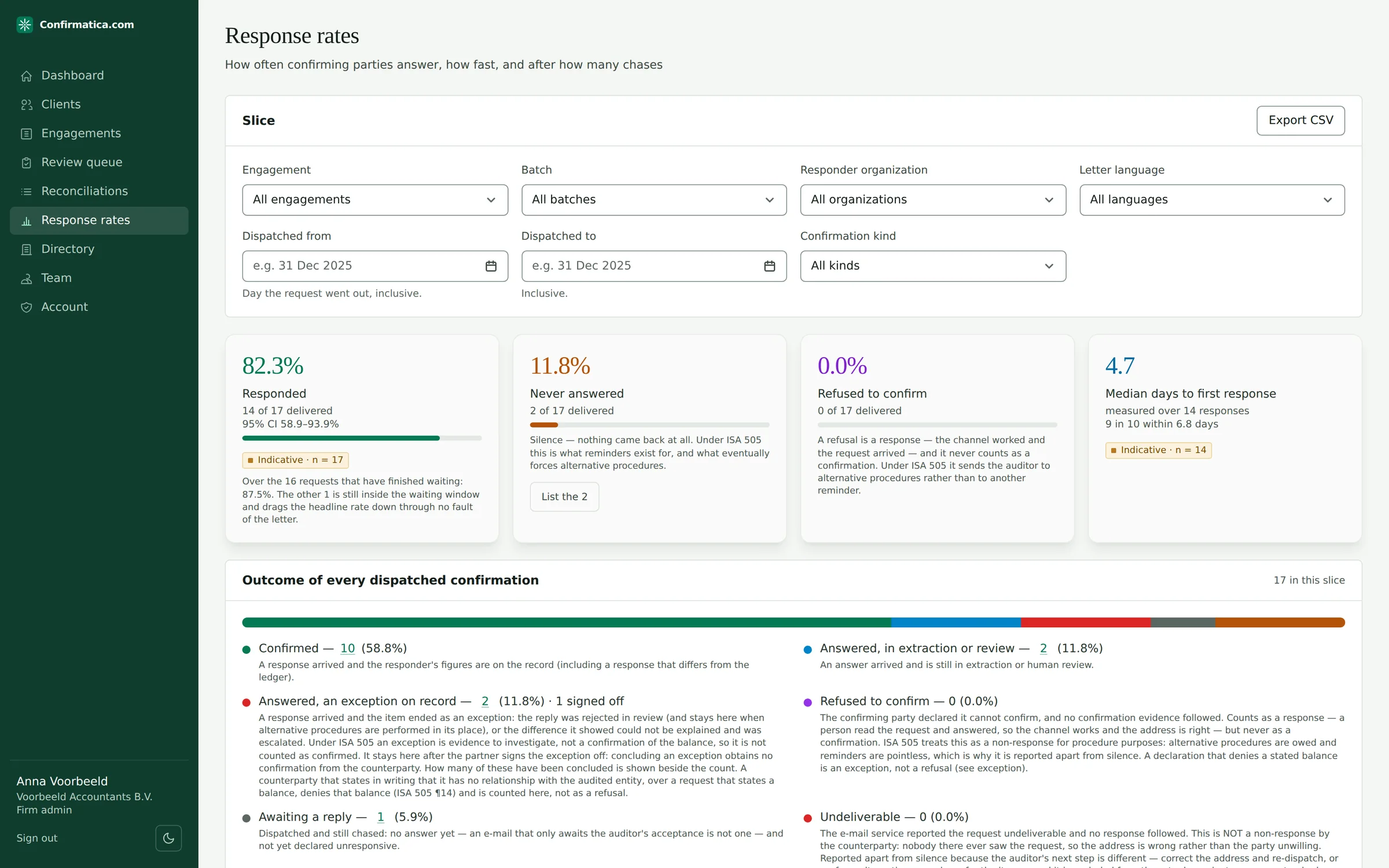
The platform reports how many requests have been answered and how they turned out, how long an answer takes — the middle of the distribution and the slow tail, not an average that hides it — and how many reminders it took to get the first reply. The figures can be read for one engagement, one batch, one window of time, one kind of request, one language, or one counterparty, and they export for a partner who wants them in a schedule of their own.
Which counterparty never answers
Non-response by responding organization, worst first, each row carrying how many requests it is measured over — so a bank that ignored one request is not confused with one that has ignored twenty.Refusal is not non-response
A desk that declined is counted as having declined. The two need different work from the auditor, and a rate that merges them tells a partner to chase someone who has already answered.
Ask for a walkthrough from the responder's side
A demonstration runs on synthetic data, and the responder's screens are the half worth watching: what a bank desk is asked, in which language, and how few steps it takes to finish.