The firm operates the deployment, which answers most of this page
Confirmatica is licensed, not rented. A licensee deploys it on their own infrastructure, under their own accounts, so the audit data it holds sits inside an environment the firm already controls and already had to account for. Most questions a partner or a firm's counsel asks about data handling are answered by that arrangement rather than by an undertaking from a supplier — which is the point of licensing it rather than renting it.
Two roles, and they are not the same party
The audit firm, for the audit data
The engagements, the client companies, the counterparties, the replies and the working papers are the firm's. The firm decides what is collected, how long it is kept and who inside the practice may see it, because the firm runs the deployment those decisions are made in.Bonfleur s.r.o., as controller of a narrow scope
The company behind Confirmatica is the controller for visitors to this site and for the enquiries sent through it. That is the whole of what it controls, and it is set out in the privacy notice. Where it handles audit data at all — supporting a deployment, or during a demonstration — it does so as a processor, on the firm's written instructions, under a written agreement that says what may be done with it and what happens to it at the end. That agreement, not this page, is where a firm's counsel settles the detail.
An audit file is not aged out on a timer
Nothing in the platform removes audit evidence on a schedule today. Two things follow, and they are different in kind. The first is a position: the period that applies to a working paper is set by the firm's own professional and statutory obligations, which differ by jurisdiction and by engagement, so a supplier's default that quietly deleted a paper at some anniversary would be the wrong default in most practices. The second is honest about the state of the software: the periods a licensee sets are agreed in the licence conversation, and carrying them out on a schedule is work planned rather than work shipped. A firm that needs it enforced before it signs should say so, because that is a requirement the customization stage exists for.
What is kept by design
The signed authorizations, the letters as dispatched, the replies as received, the working papers and the record of who did what. These are the file. They remain available to the firm for as long as the firm keeps them.What the firm decides
Everything about how long. The retention position, the disposal of a closed engagement and the handling of a client relationship that ends are the licensee's to set, and the licence conversation is where the platform's part in carrying them out is agreed.
A counterparty is asked for an answer, not for an account
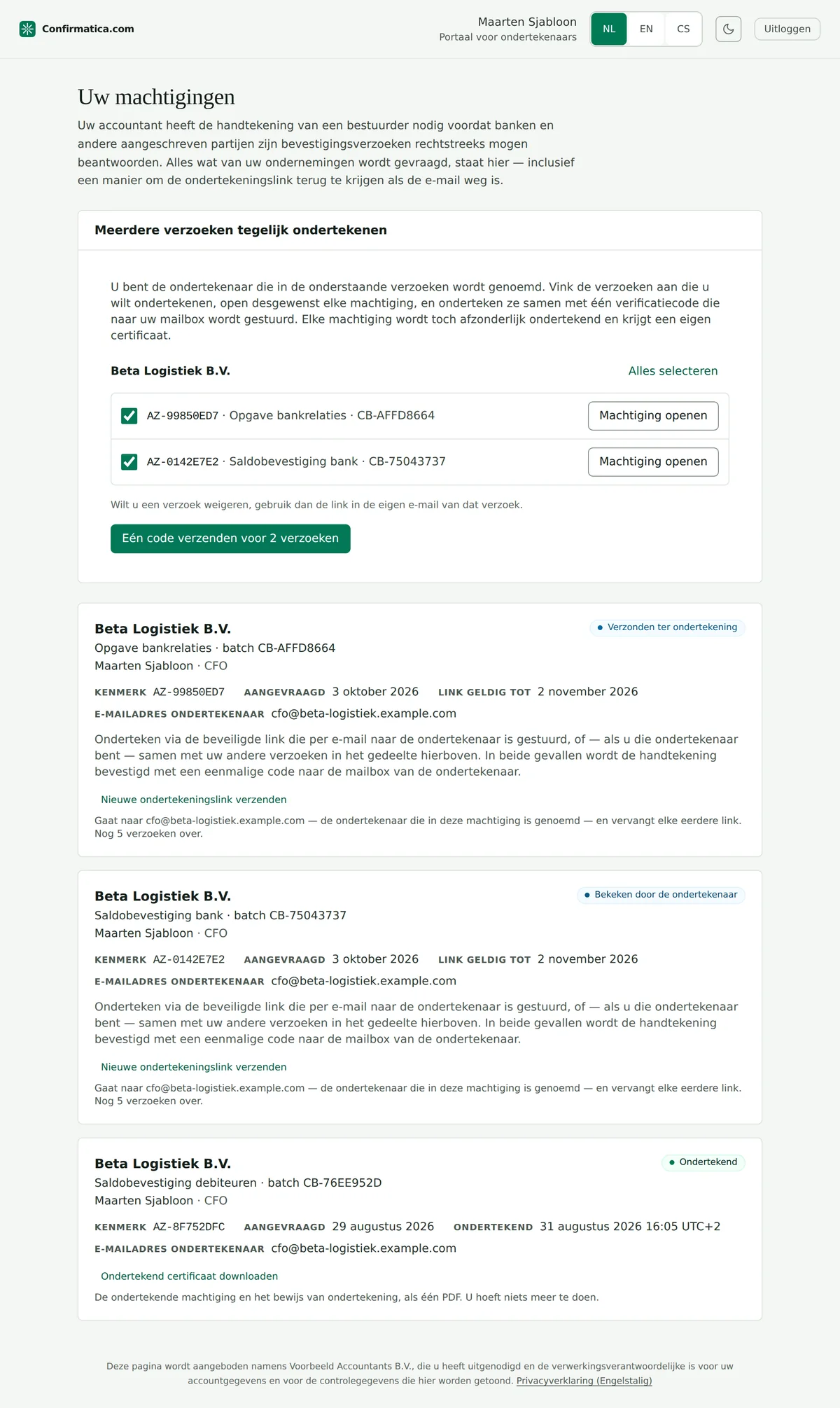
A bank clerk, a law office, an insurer and a lessor are asked one question set and give one answer. No account is created for them, no password is held on their behalf, and the link they are sent is single-purpose and expires. The audited company's director signs the authorization that releases the information and is shown their own authorizations and certificates — and nothing of the auditor's figures or deadlines. The authorization names the counterparties it covers, because that is what the director is releasing.
Enclosure — the audited company's director, on their own page
A confirmation is an outbound letter by design, and a model reads the reply
The page above would be misleading without this one. A confirmation only works because something leaves: a letter goes to a bank, a law office, an insurer or a lessor, and for a balance request it carries the figure being confirmed, because that is what the counterparty is being asked about. That is the procedure, not a side effect of it, and the audited company authorizes the release in writing before any of it is sent.
Who reads the reply
Replies are read by a model, and what it produced is recorded as its own numbered section of the working paper — what was proposed, and the named person who accepted, corrected or rejected it. Nothing it produced becomes evidence on its own.Whose model
The licensee's. Under this licence the firm deploys on its own systems, and that includes whoever performs the extraction — alongside the firm's own sign-in, its own document storage and its own records. A firm that has already assessed a supplier for this and approved it keeps that supplier; the customization stage is where the choice is made, and it is the firm's to make.
The specifics are documented, and they are not published here
A partner deciding whether to license this needs the detail; publishing it on a marketing page serves nobody and hands a map to people it was not written for. Architecture and security documentation is available under NDA. The licence conversation is also where source escrow, dependency disclosure and the maintenance arrangement are covered — those are matters for an agreement, not claims for a website.
What the platform deliberately does not do is set out on the scope page.
Ask for the documentation
A firm's counsel and a firm's IT function ask different questions, and an enquiry that names which one is asking gets a more useful answer. What can be shared under NDA is settled in that conversation.